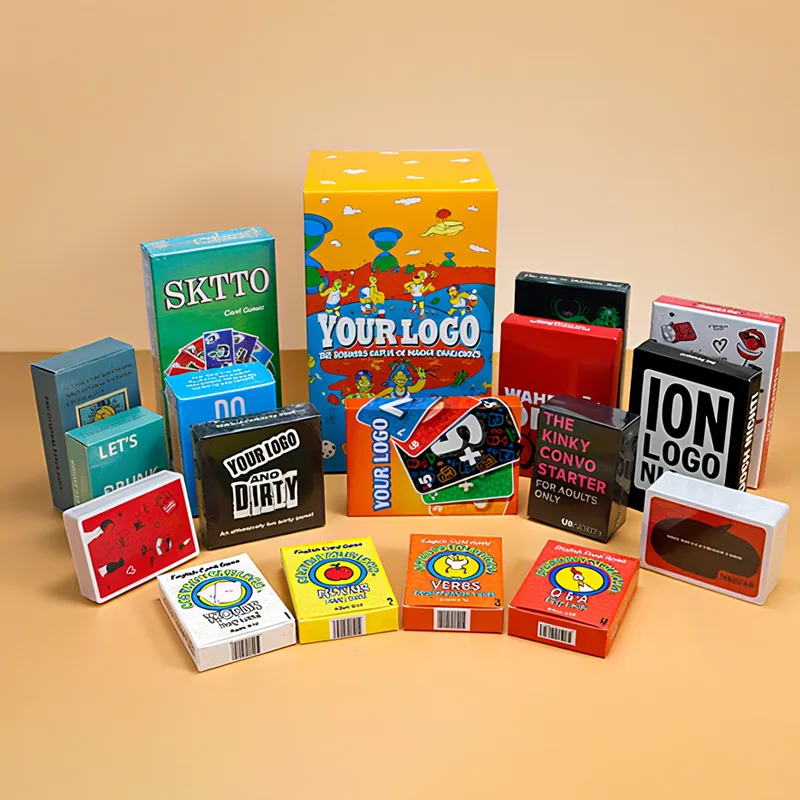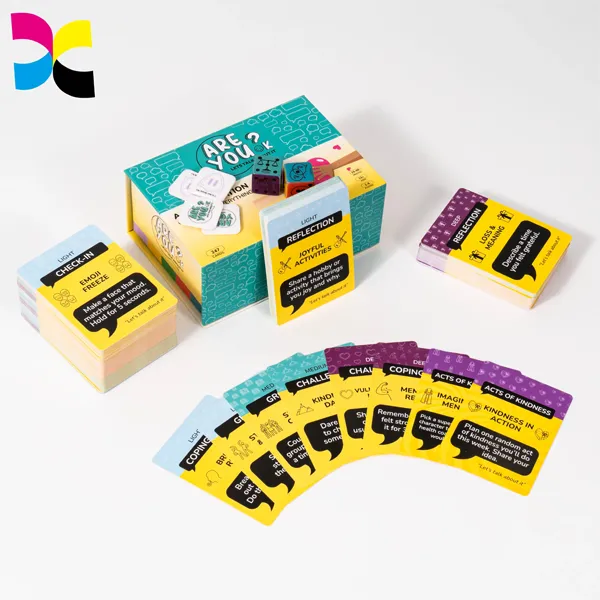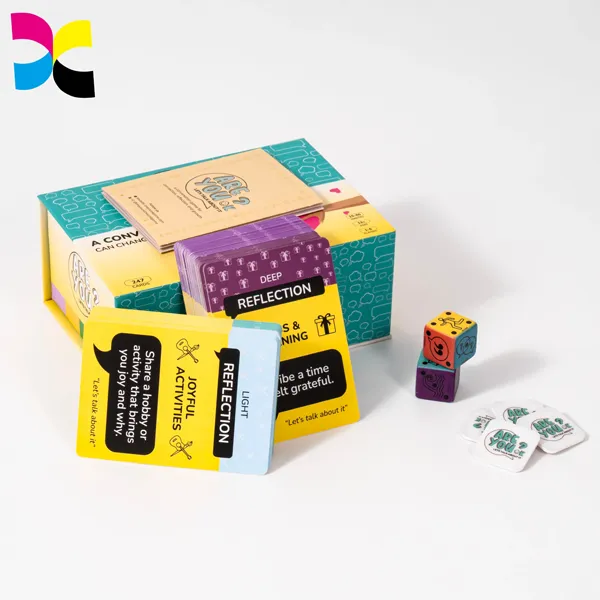
Trading card thickness decides how a deck feels in the hand, how it shuffles, and whether it fits the box you designed around it. Specifying it is harder than quoting one number, because the finished card is built from a printed sheet, a core layer, and a protective finish.
This guide explains the three systems used to describe card stock and publishes the finished caliper figures we quote for our own coated stocks. It also shows what changes those numbers before a card reaches your customer.

Three Ways to Measure Card Thickness
Suppliers, collectionneurs, and mills each use a different unit, and the three systems measure different physical properties. Knowing which one a specification uses prevents most ordering mistakes.
Millimetres and Microns
Millimetres measure the physical thickness of the finished card directly, which is why factories use them for production checks. A micron is one thousandth of a millimetre, so a card measuring 0.35 mm also measures 350 microns. When you send a caliper target to a manufacturer, this is the least ambiguous way to state it.
Points and Mils
A point, also called a mil in North America, is one thousandth of an inch. Because the inch is defined as exactly 25.4 millimetres, one point equals 0.0254 mm. UN 14 pt card is therefore 0.3556 mm thick. Card stock thickness in the United States is usually quoted this way, and collectors often specify it when choosing sleeves and grading slabs.
GSM and Pounds
GSM stands for grams per square metre. It describes the mass of a one square metre sheet, which makes it a measure of grammage rather than thickness. The same property appears in US quotes as pounds per ream. Our guide de conversion du grammage du papier covers the arithmetic: 300 gsm equals about 111 lb cover, 350 gsm about 129 kg, et 400 gsm about 148 kg.
Why GSM Does Not Equal Thickness
Weight and thickness correlate, but they are not the same measurement. Two sheets at identical GSM can caliper differently because bulk depends on fibre composition, how the layers are bonded, and how hard the sheet is calendered at the mill.
That is why our materials page prints a caveat under its thickness table: the figures are reference only, and actual thickness varies by mill and paper construction. The same page states that we confirm the current paper mill, GSM, épaisseur, and finish compatibility when quoting an order, rather than assuming a universal conversion.
The practical consequence is simple. Use GSM to compare material cost and general substance, use millimetres or points when the finished dimension matters, and measure a physical sample when a tolerance has to hold.
Finished Thickness by Paper Weight
The table below reproduces the varnished and laminated figures published on our materials page for C2S coated art paper. The point column is our own arithmetic, converting each millimetre value at 0.0254 mm per point.
| Stock | Varnished | Feuilleté | Varnished (pt) | Feuilleté (pt) |
|---|---|---|---|---|
| 300 GSM C2S | 0.325 mm | 0.357 mm | 12.8 pt | 14.1 pt |
| 350 GSM C2S | 0.382 mm | 0.4125 mm | 15.0 pt | 16.2 pt |
| 400 GSM C2S | 0.416 mm | 0.458 mm | 16.4 pt | 18.0 pt |
Read these as coated art paper, not as a core board. A blue core or black core sheet at the same GSM will not land on the same line, which is the point of the next section. Our trading card paper guide describes the stock families behind those categories.
How the Core Layer Changes Caliper
A playing card is not one sheet. It is a front printable layer, a middle core, and a back printable layer bonded together, as our paper core selection guide explains. The core blocks light and adds bulk, so it drives both the final thickness and the opacity of the card.
Our materials page lists five core grades: white, gris, purple, bleu, and black. Each one adds a different amount of material between the face sheets.
- Noyau blanc. The cost-conscious option, with good printability and basic stiffness for lower-frequency use. We position it for promotional cards, event decks, and entry-level projects.
- Grey and purple core. Mid-range grades between white and the coloured casino stocks, quoted on request alongside the print specification.
- Noyau bleu. A coloured middle layer that improves opacity over white core. Our black core cardstock article places it around 280–330 gsm for standard playing cards and entry-level trading cards.
- Noyau noir. A solid black inner layer that blocks light almost completely and adds rigidity, typically specified from 300 à 400 gsm for competitive decks and collector products.
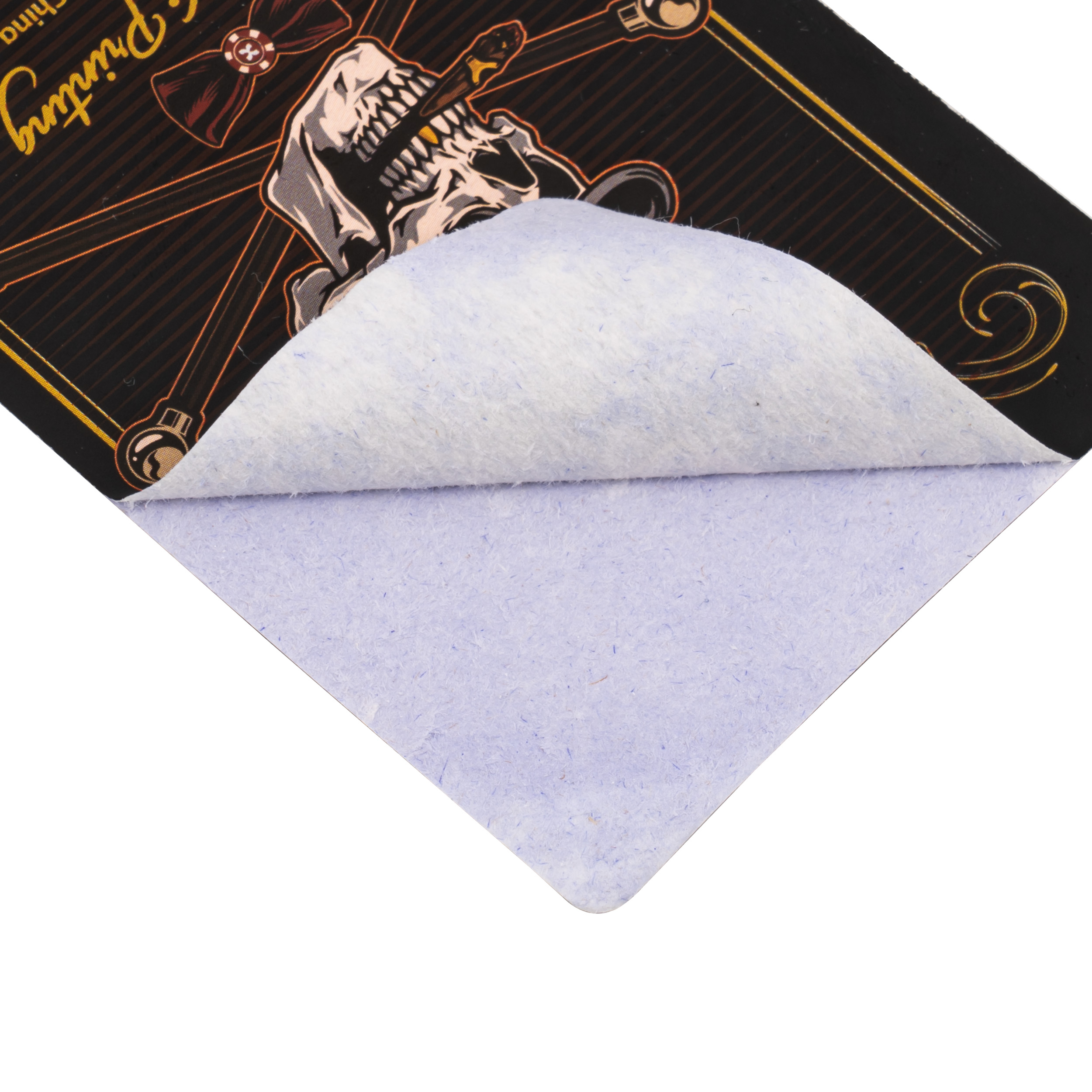
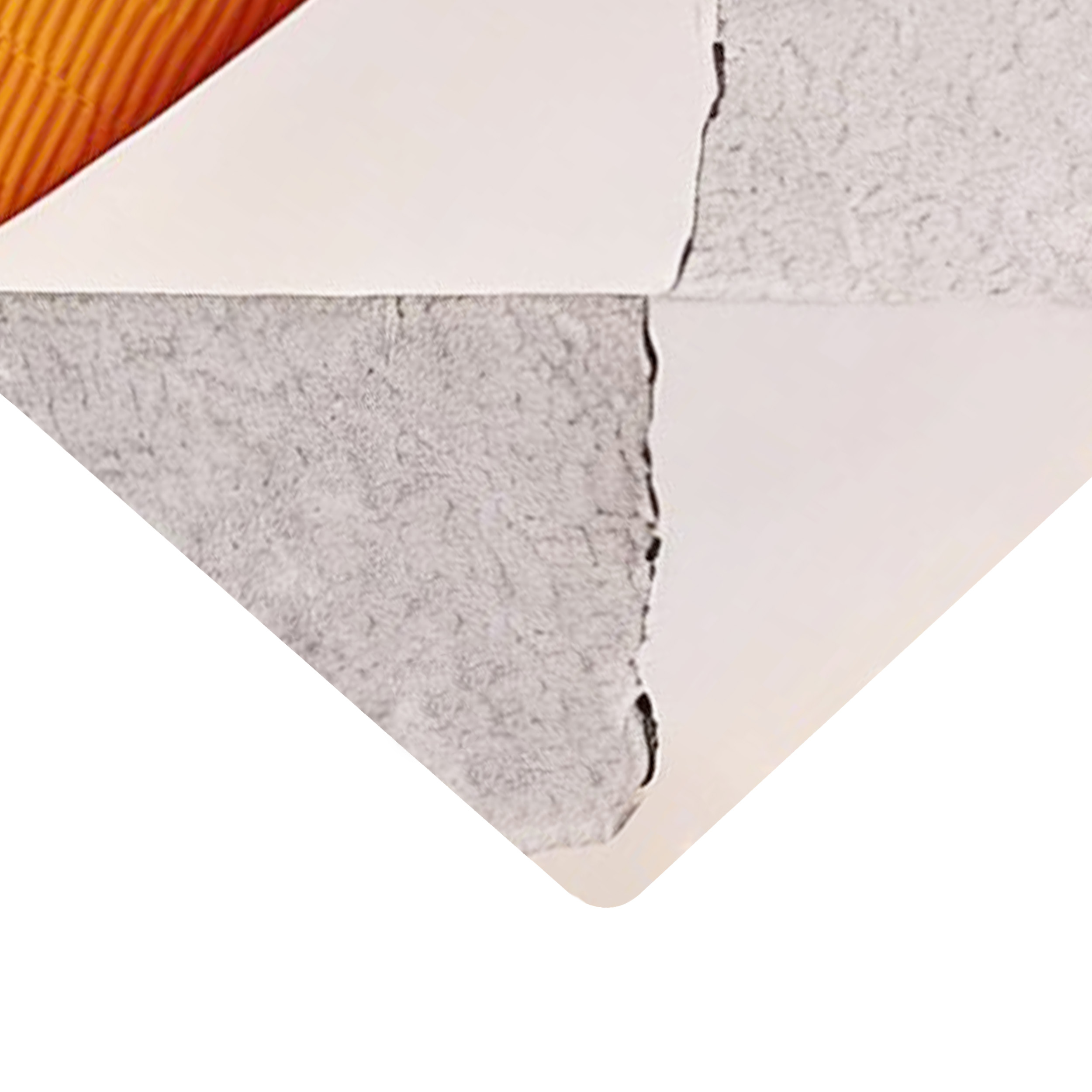
One quick field test comes from our own black core article: tear a card in half. A black core shows a dark inner layer, a blue core shows a thin blue line, and white core looks plain white through the cut. A digital caliper on the torn edge turns that inspection into a number you can quote back to a supplier.
How Lamination Adds to Caliper
The finish applied after printing is a real thickness contributor, not a cosmetic footnote. Subtract the varnished column from the laminated column in the table above. The gap is 0.032 mm at 300 GSM, 0.0305 mm at 350 GSM, et 0.042 mm at 400 GSM. In practice, plan on roughly 0.03–0.04 mm for a laminated card.
That matters because lamination is chosen for protection and hand feel rather than dimension. Our finishes page lists gloss, mat, soft-touch, anti-scratch, and linen films, each of which changes glare, texture, and stack height. The same page warns that embossed or debossed areas need the stock thickness confirmed before approval.

How Trading Card Thickness Affects Performance
Snap and shuffle. Our paper core guide defines snap as how quickly a card returns to shape after bending. It describes black core cards as more rigid and more responsive during a riffle shuffle, which is why professional decks lean on that stock.
Opacité. The core layer prevents light passing through, so opponents cannot read card faces through the back. That is a game integrity requirement in competitive play, and it is the main reason a thicker black core card is chosen over a heavier white core sheet.
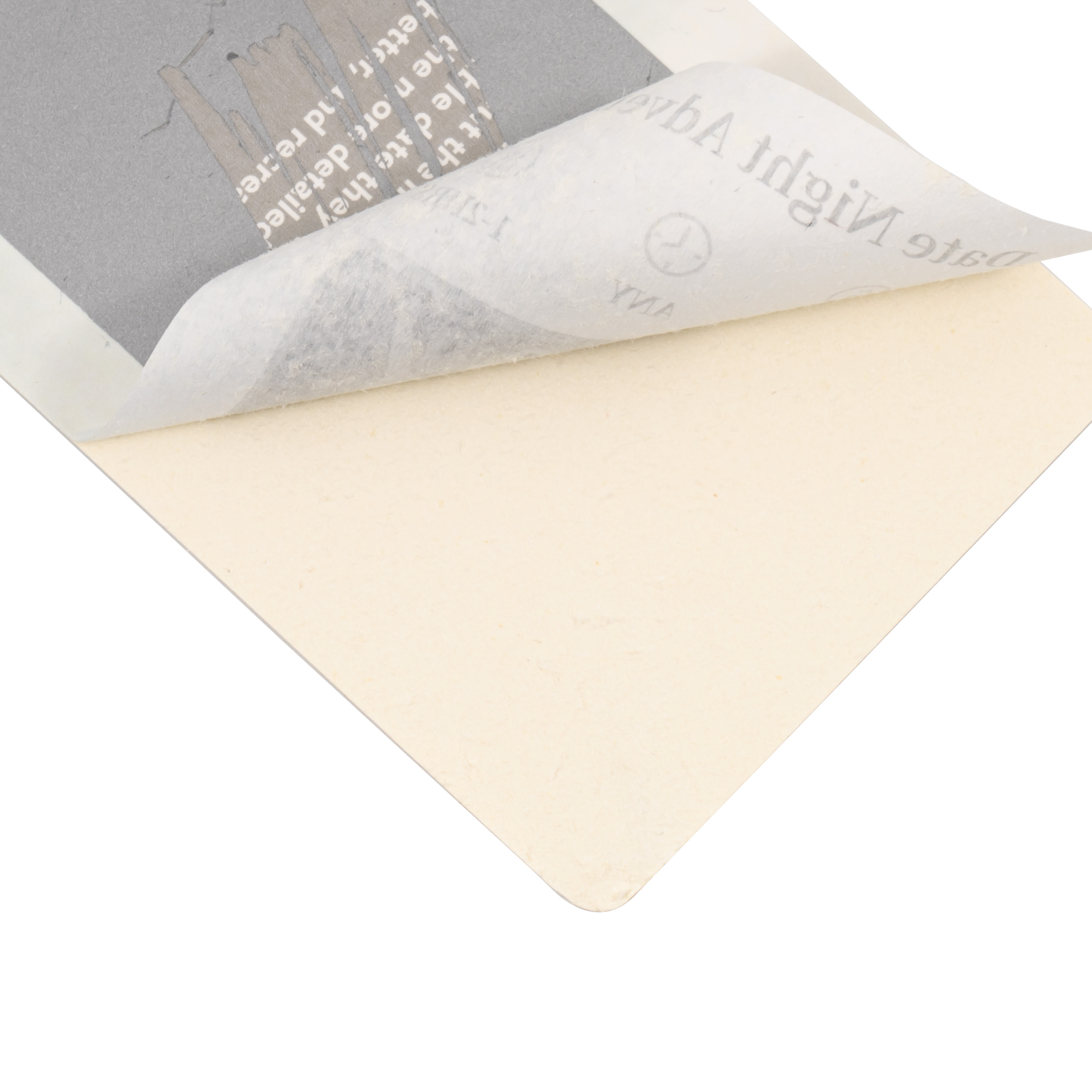
Edge appearance. A black core produces a dark, uniform cut edge, while white core leaves a pale line along the border that shows on darker designs.
Durabilité. Heavier core stocks resist bending, froissement, and tearing better under repeated handling, according to our black core comparison.
Stack height and packaging. Card count multiplies every millimetre. Our packaging page states that card stock, état de surface, deck count, and accessories all change the finished stack height and internal clearance. Lock the product before you approve the box dieline.
When Thicker Card Stock Is Wrong
More thickness is not automatically more quality. A heavier deck costs more to ship, needs a larger box, and can feel stiff in a game that depends on frequent shuffling.
Some products actively want less. A study deck that students write on works better on uncoated or lighter stock. Our flashcard paper guide recommends 250–300 gsm for classroom products and 300–350 gsm only for premium retail sets. For the sizing side, see flashcard dimensions.
Other projects need a different material rather than a heavier sheet. Our paper versus plastic comparison covers 100% PVC and polyester stocks for waterproof, high-turnover use, where paper thickness is the wrong specification entirely. Card game decks that live in a component tray have their own constraints, covered in our game card printing service page.
How to Specify Thickness in an Inquiry
Our materials page asks for five inputs before it recommends a stock: intended use, quantité, desired stiffness, finition, and target cost. The packaging page adds the box side of that question. It asks for finished card size, cards per deck, number of decks, extra components, preferred opening style, and target retail and freight pack-out.
A standard card deck supplied with its box starts at 200 ensembles, and a material sample pack lets you compare paper, revêtement, and lamination by hand. Samples may be free, with international freight paid by the buyer, as our sampling page explains. Start from a custom playing card project ou taille de la carte à collectionner reference if you are still fixing dimensions.
Foire aux questions
How thick is a standard trading card?
Our materials reference puts 350 GSM coated stock at 0.382 mm varnished and 0.4125 mm laminated, which converts to about 15 à 16 points. Core choice and finish move the final number, so measure a sample before you commit.
Is 300 GSM too thin for cards?
Not necessarily. In our table, 300 GSM calipers at 0.325 mm varnished and 0.357 mm laminated, roughly 13 à 14 points. That range suits promotional decks and games handled less often, where a lighter card is an advantage.
How many points is 350 GSM card stock?
There is no fixed answer, because GSM measures mass and points measure thickness. Using our published figures, 350 GSM coated stock converts to 15.0 points varnished or 16.2 points laminated.
Does lamination change card thickness?
Oui. Our reference figures add 0.0305 à 0.042 mm between the varnished and laminated columns. Budget for roughly 0.03 à 0.04 mm before you fix box clearances.
How do I check which core a card uses?
Tear a card in half and look at the cut face. A black core reads dark, a blue core shows a blue line, and white core looks plain white. Measure the torn edge with a digital caliper to record the thickness as well.
Pensées finales
Thickness is three numbers in a trench coat: a mass figure in GSM, a direct caliper reading in millimetres or points, and a finish allowance added by lamination. Treat GSM as the material cost dial and millimetres as the dimension you actually control.
Use the reference table as the starting point for trading card thickness. Confirm the core grade against how the deck will be handled, and measure a physical sample before the box dieline is locked. That sequence keeps a premium feel from becoming a packaging problem.
Compare Card Stock in Hand