Flashcards have been used as a learning tool for decades, and for good reason. Simple in form yet powerful in practice, flashcards help learners actively recall information, reinforce memory, and study more efficiently.
하지만, not all flashcards are the same. From basic question-and-answer cards to image-based and fill-in-the-blank formats, different types of flashcards are designed for different learning goals. As a professional card printing manufacturer working with educators, 출판사, and educational brands worldwide, we often see confusion around which flashcard type works best—and how those cards are actually made.
This guide walks you through the different types of flashcards, how they are used, and how to choose the right format for your learning or printing project.
What Are Flashcards and Why Are They So Effective?

Flashcards are learning cards that present information in small, digestible pieces—usually with a prompt on one side and an answer on the other. They are widely used for memorization, concept reinforcement, and long-term retention.
What makes flashcards effective is active recall. Instead of passively reading, learners must retrieve information from memory, which strengthens neural connections. Flashcards also work well with spaced repetition, allowing learners to review content at optimal intervals.
Because of this flexibility, flashcards are used across age groups and subjects—from early childhood education to language learning, medical studies, and professional training.
Read Now: 아이들과 함께 플래시카드를 효과적으로 사용하는 방법
4 Main Types of Flashcards (With Examples)
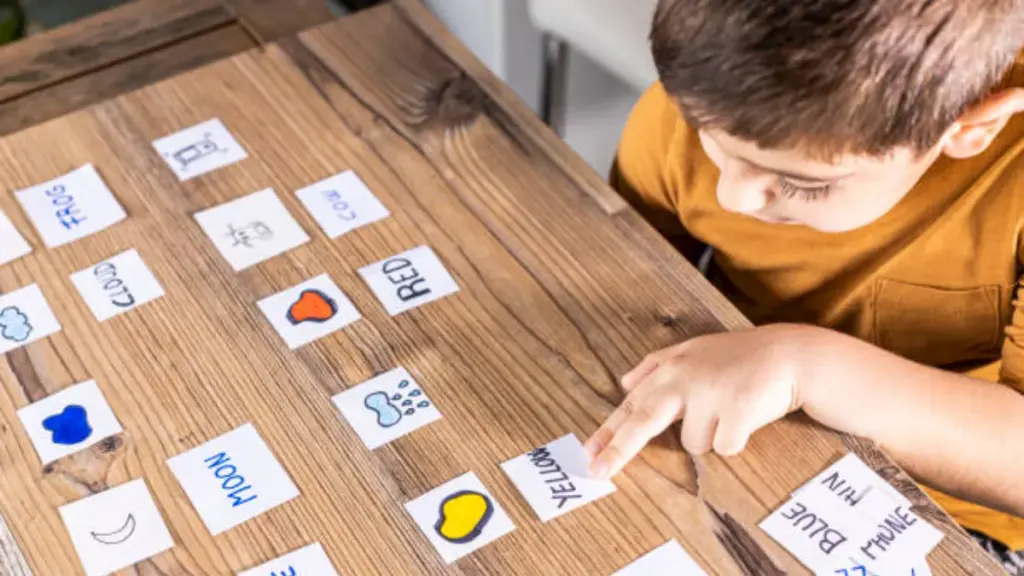
Although 플래시카드 can be customized in countless ways, most fall into 4 core types. Understanding these foundational formats helps you choose the right structure before thinking about design or production.
Traditional Question-and-Answer Flashcards
This is the most common flashcard format. One side shows a question, term, or prompt; the other provides the answer or explanation. This format works best when learners need clear, direct recall.
Common uses:
- Exam preparation
- General knowledge review
- Training and certification programs
Vocabulary and Definition Flashcards
Vocabulary flashcards are a variation of the question-and-answer format, but they focus specifically on words and meanings. One side usually features a word, while the reverse explains the definition, pronunciation, or example sentence.
Common uses:
- Language learning
- Academic terminology
- Professional or industry-specific vocabulary
These flashcards are often produced as sets and may include visual cues or icons to support memory, especially for younger learners or second-language students.
Image-Based Flashcards
Image-based flashcards rely heavily on visuals. One side typically shows a picture, symbol, or illustration, while the other includes a word, label, or explanation. For children, image-based flashcards are especially effective.
Common uses:
- Early childhood education
- Visual learning
- Object recognition and concept building
Cloze Deletion (Fill-in-the-Blank) 플래시 카드
Cloze deletion flashcards present a sentence or statement with a missing word or phrase. The learner must recall and fill in the blank mentally before checking the answer.
Common uses:
- Advanced language learning
- Medical, legal, or technical studies
- Concept-based memorization
These cards are especially effective for learners who already understand the basics and want to strengthen contextual recall rather than simple definitions.
Digital Flashcards vs. Physical Flashcards
Flashcards have a long history that predates modern classrooms and technology. The earliest forms can be traced back to the 19th century, when educators used handwritten cards to help students memorize facts, vocabulary, and formulas. These physical cards became popular because they were simple, 가지고 다닐 수 있는, and effective for active recall.
As learning moved into the digital age, digital flashcards emerged in response to new study habits and technologies. Computers, smartphones, and learning apps made it possible to store large numbers of cards, automate review schedules, and study anytime without carrying physical materials. Spaced repetition algorithms and cloud-based access further accelerated the adoption of digital flashcards, especially among students and self-learners.
하지만, the rise of digital flashcards did not replace physical ones. Instead, the two formats now coexist, each serving different learning styles, age groups, and use cases.
Below is a clear comparison to help you understand how digital and physical flashcards differ in practice.
| Aspect | Digital Flashcards | Physical Flashcards |
|---|---|---|
| Format | App-based or web-based | Printed cards made from paper or board |
| Portability | Accessible on phones, tablets, or computers | Portable but require physical storage |
| Learning Experience | Screen-based, often automated | 촉각, hands-on interaction |
| Best For | Independent learners, exam prep, large content sets | Children, 교실, group activities |
| 사용자 정의 | Easy to edit content digitally | Fully customizable in size, material, 마치다 |
| 내구성 | Depends on device and software | Depends on paper, 두께, 및 라미네이션 |
| Classroom Use | Limited by device availability | Ideal for shared and interactive learning |
| 소매 & Educational Products | Not suitable | Commonly used for packaged learning products |
Best Practices for Studying With Different Types of Flashcards
No matter which type you use, effective flashcard study follows a few core principles:
- Keep information concise—one idea per card
- Shuffle cards regularly to avoid memorization by order
- Review difficult cards more frequently
- Combine flashcards with active recall and spaced repetition
How Different Types of Flashcards Are Designed and Produced
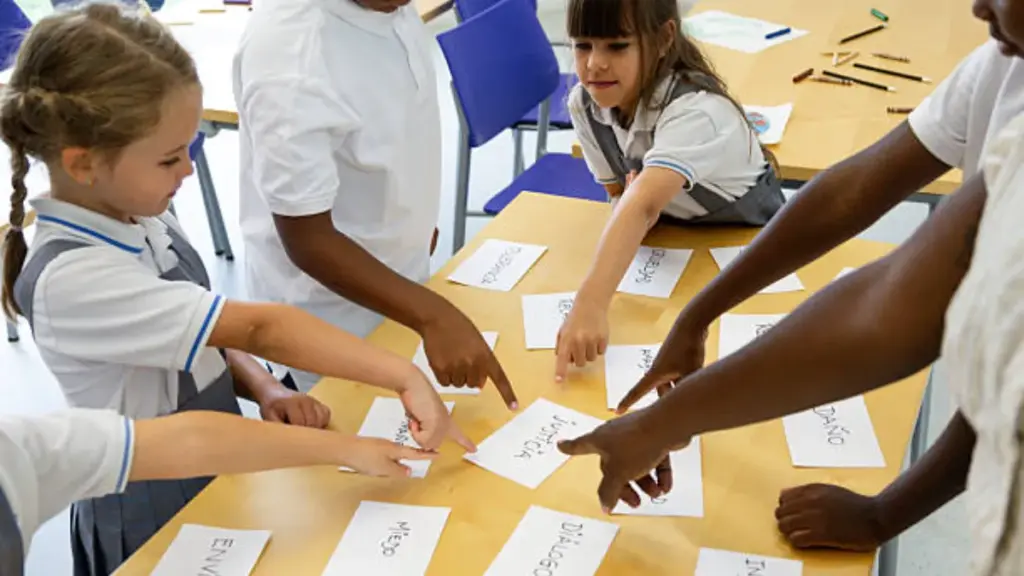
From a professional manufacturer’s viewpoint, each type of flashcard has its own design and production considerations. ~에 신이 인쇄, we see this every day when we help clients turn ideas into physical products.
- Content planning
- Decide the goal: early education, exam prep, 언어 학습, therapy, or branding.
- Choose the card type: Q&에이, vocabulary, image-based, cloze, or a mix.
- Plan the number of cards, categories, and any color‑coding or icon system.
- Graphic design and layout
- Select card size (예를 들어, poker size, bridge size, 미니 카드, or custom sizes).
- Choose fonts that are clear and readable at small sizes.
- For image-based sets, ensure high‑resolution artwork and consistent style across the deck.
- Add design elements such as borders, 아이콘, and background colors while keeping the learning content easy to see.
- Material selection
- Cardstock thickness: Thicker stocks feel more premium and withstand heavy use. Common choices include 250–350 gsm or custom boards for flashcards used in schools.
- Finish: Matte lamination for less glare in classrooms, or glossy lamination for vibrant colors and easier cleaning (useful for kids’ cards).
- Corners: Rounded corners improve safety and reduce wear, especially for children’s and therapy cards.
- Printing and color management
- Use high-quality printing processes (such as offset printing) to keep colors accurate from the first card to the last card.
- Calibrate colors for images so skin tones, diagrams, and product branding look correct.
- For sets with multiple color groups, ensure each group is clearly distinguishable but not too aggressive on the eyes.
- 절단, 대조, 그리고 포장
- Precision cutting keeps card edges smooth and uniform.
- Cards are sorted and stacked in the correct order or grouped by category, according to the client’s plan.
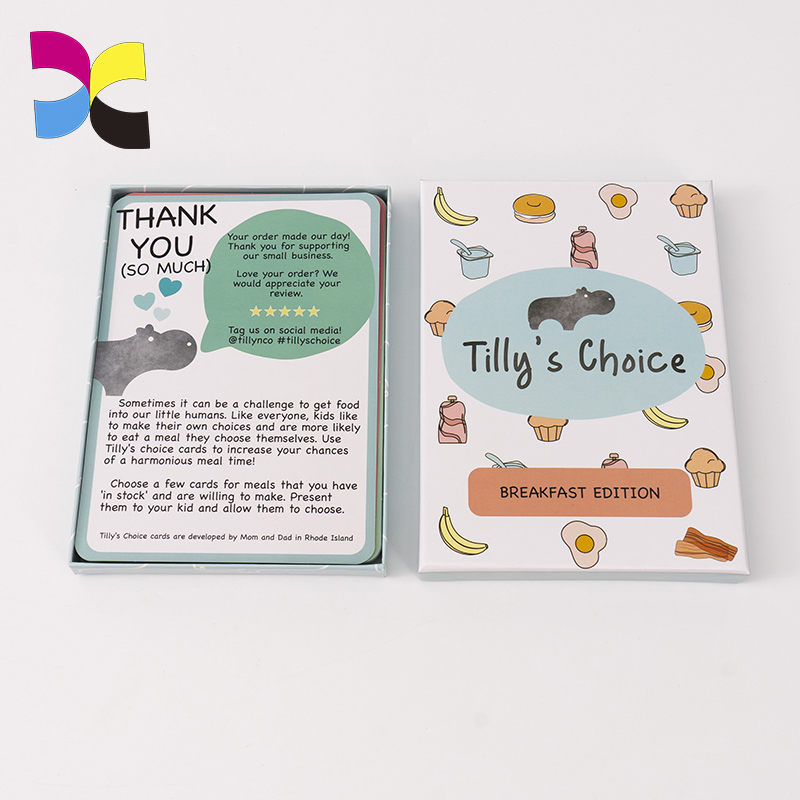
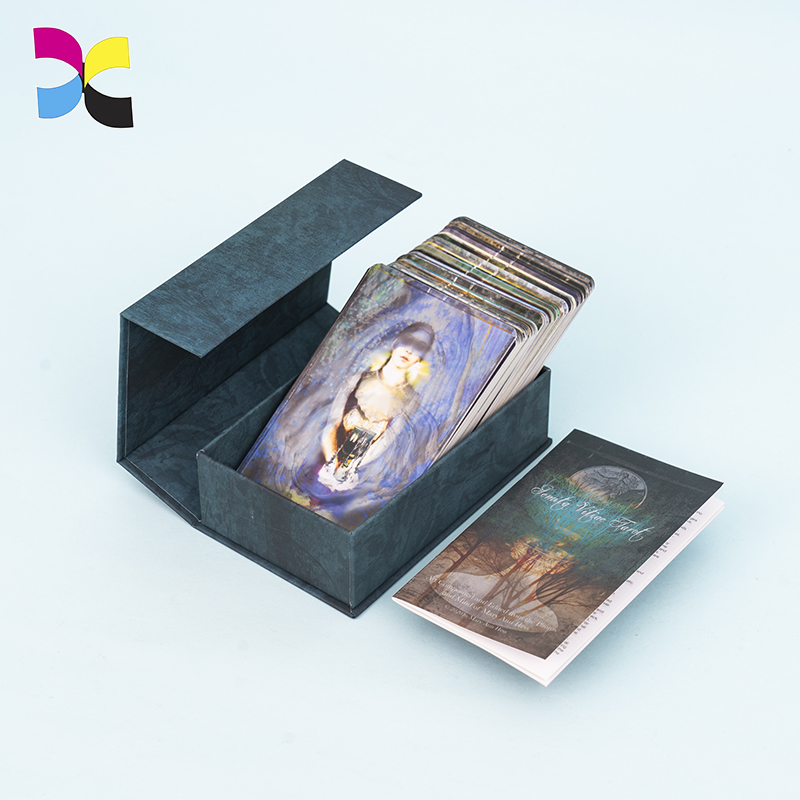
- Packaging options include tuck boxes, 단단한 상자, 자기 상자, or custom cases. Many educational publishers print instructions or quick‑start guides inside the box.
Working with an experienced flashcard printer like Xinyi Printing means you can focus on the educational content while relying on us to handle the technical side—materials, 완료, color consistency, and packaging—to produce a durable, professional product that reflects your brand.
Choosing the Right Flashcard Type for Your Project
Choosing the right flashcard type starts with one simple question: how will the cards actually be used? Different learning scenarios place very different demands on size, material, and structure.
For children and early learners, image-based physical flashcards made from thick board are usually the best option. They are easier to handle, 더 내구성, and safer for frequent use. Rounded corners and sturdy materials help the cards last longer in real classroom or home environments.
For language learning, vocabulary and fill-in-the-blank flashcards are widely used. These can be produced on standard paper or laminated for repeated practice. Clear layouts, readable fonts, and consistent card sizes are more important here than decorative design.
If the flashcards are intended for exam preparation or professional study, question-and-answer formats work best. Learners typically prefer compact, easy-to-review sets with clean typography and a durable finish that can withstand heavy use.
For classrooms or retail educational products, physical flashcards remain the preferred choice. They support group interaction, do not rely on devices, and can be fully customized in size, material, 그리고 포장.
Common Flashcard Customization Options
Customization allows flashcards to better match learning goals and brand identity. 일반적인 옵션은 다음과 같습니다:
- Custom sizes and shapes
- Double-sided or single-sided printing
- Rounded corners for safety
- Matte or gloss lamination
- Custom packaging for retail or gifting
For publishers and brands, consistent quality across the entire set is essential, especially when producing flashcards in large quantities.
FAQs About Different Types of Flashcards
1. Is one type of flashcard always better than the others?
아니요. Each type plays a different role. Question-and-answer and cloze cards are strong for active recall, vocabulary cards build language and terminology, and image-based cards are great for visual learning and early education. The best projects often combine several types.
2. How many cards should be in a flashcard set?
There is no fixed rule, but many educational sets range from 30 에게 150 카드. Smaller sets are easier for young children or targeted topics. Larger sets are suitable for comprehensive courses or exam prep.
3. Are physical flashcards still useful if I already use an app?
예. Many learners use apps for everyday review and printed cards for focused, offline sessions or group activities. Teachers and parents also value physical cards because they can be shared, passed around, and used in games without screens.
4. Which flashcard type is best for kids?
For younger children, image-based cards with clear pictures and simple words work very well. As children grow, you can gradually add vocabulary cards and simple Q&A cards. For more ideas on working with kids, see our article “How to Use Flashcards Effectively with Kids” on the Xinyi site.
5. How do I get my own flashcards printed?
첫 번째, finalize your content and decide on the card types you want to include. Then choose your preferred size, material, 그리고 마무리. You can send your print‑ready files or work with our team to prepare them. As a specialized card manufacturer, Xinyi can guide you through sampling, production, and packaging so your flashcards are ready for teaching, selling, or distribution.
If you are planning a flashcard project—whether for a school, brand, online course, or your own learners—Xinyi can help you turn these different types of flashcards into a professional, durable product tailored to your audience and goals.