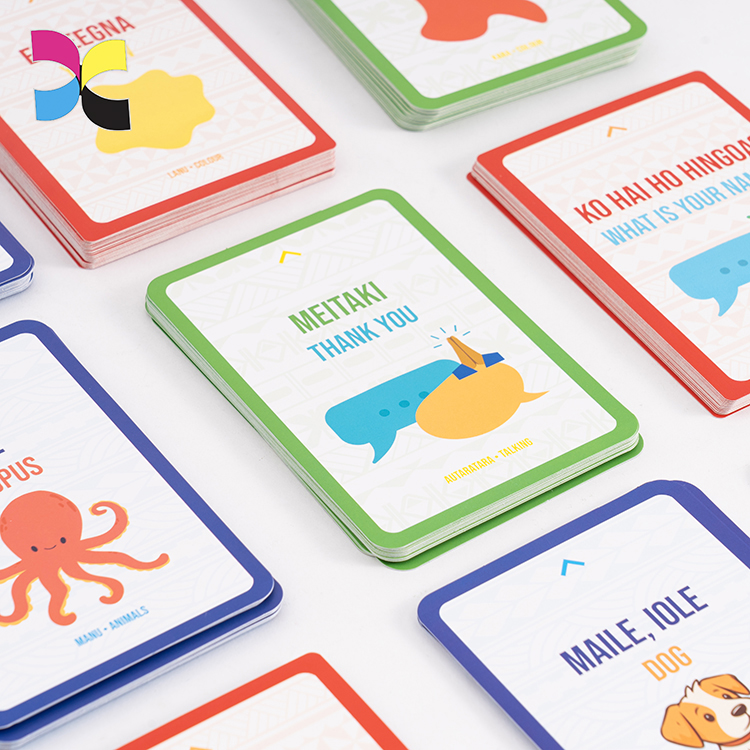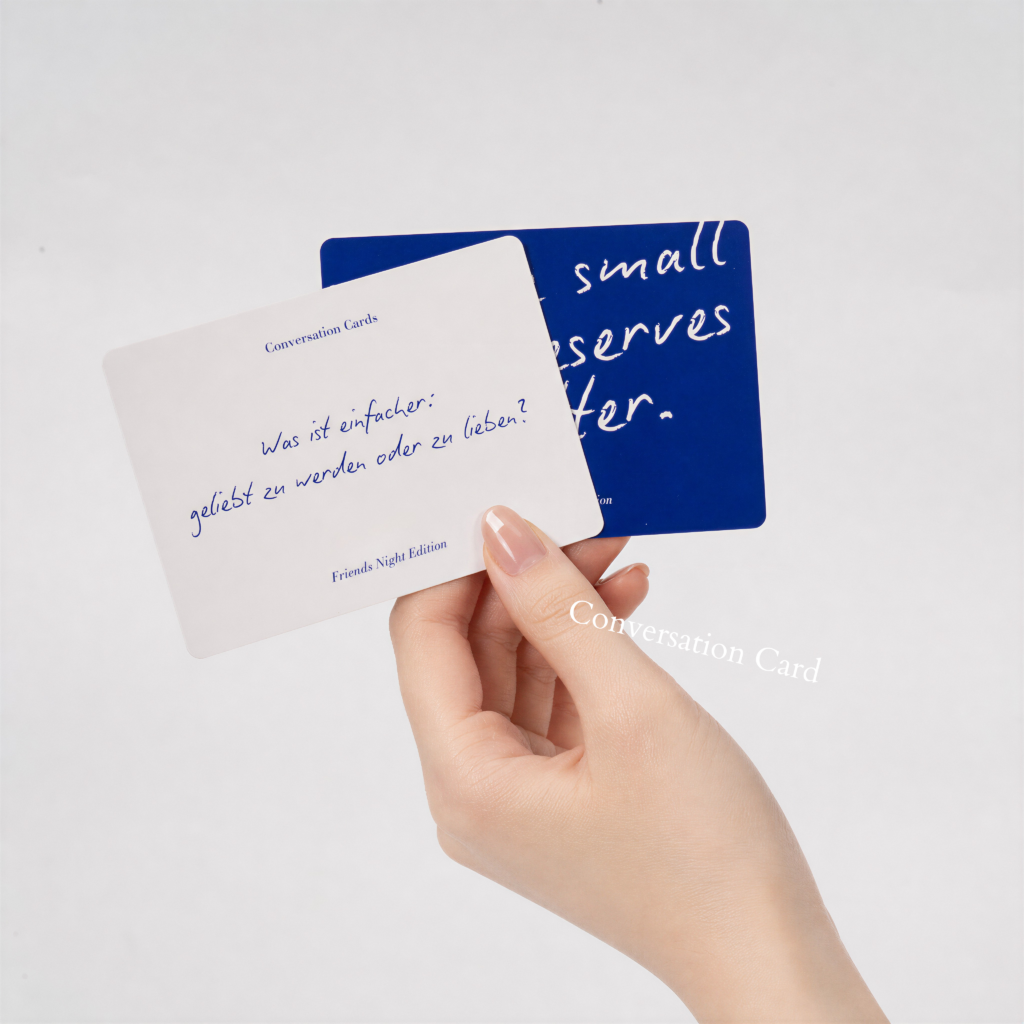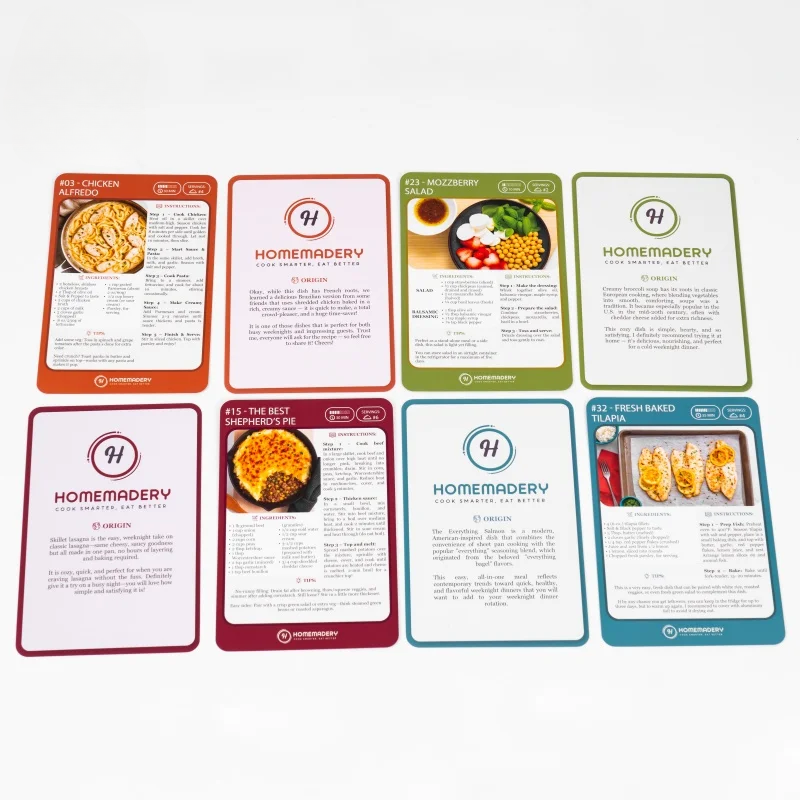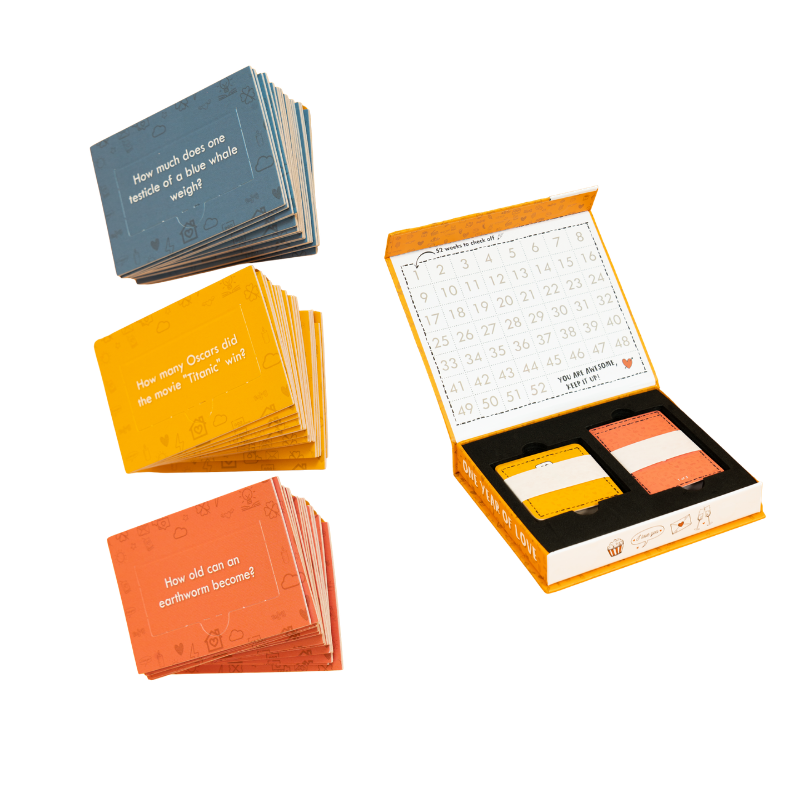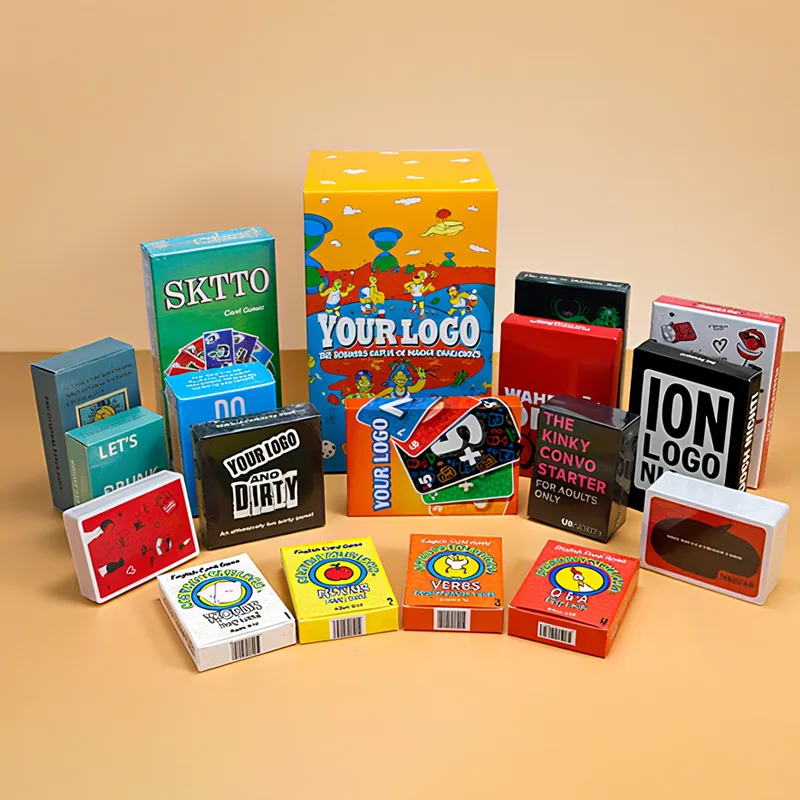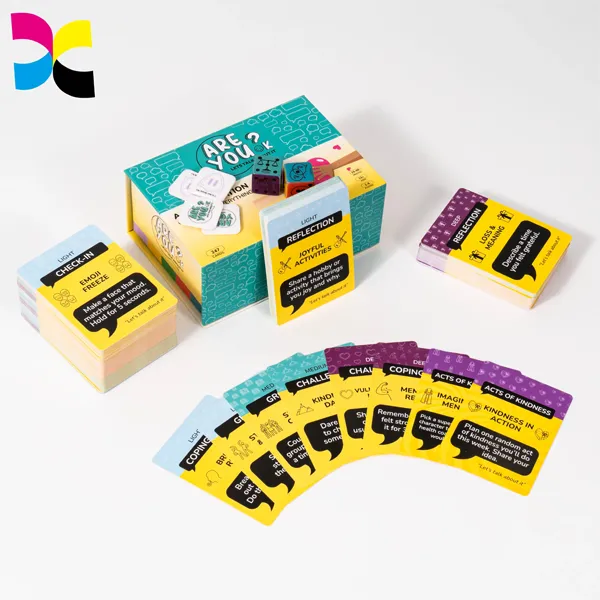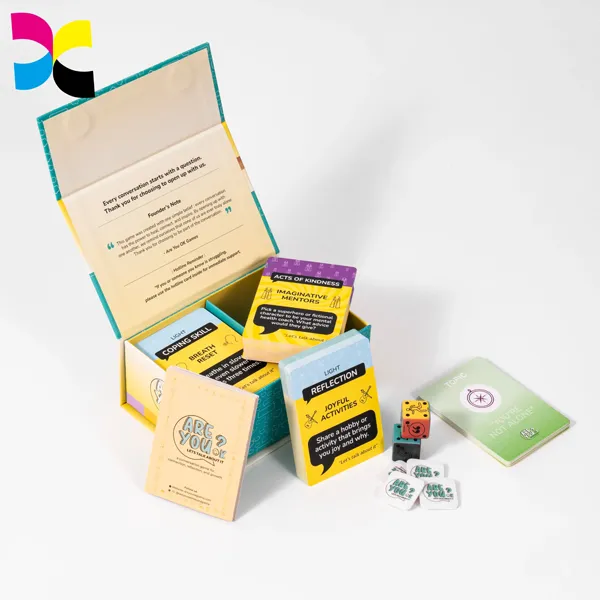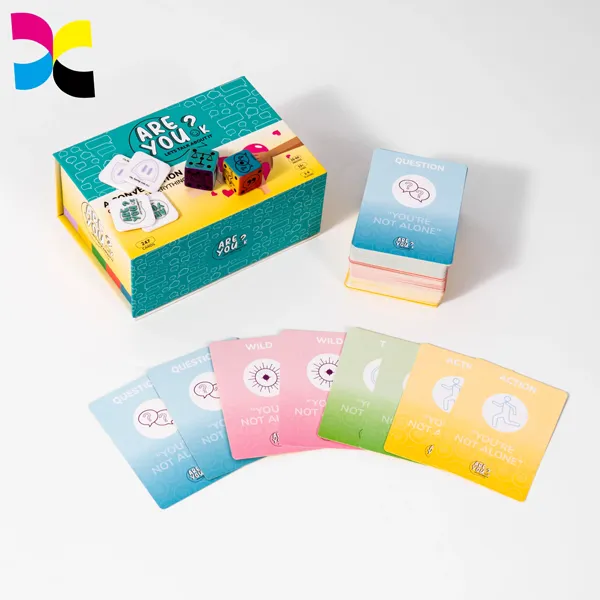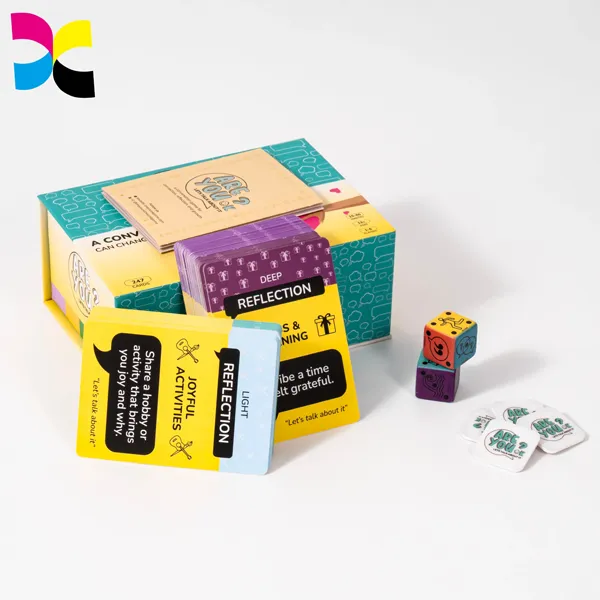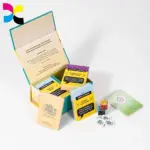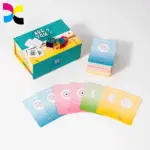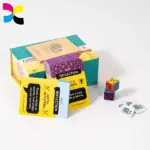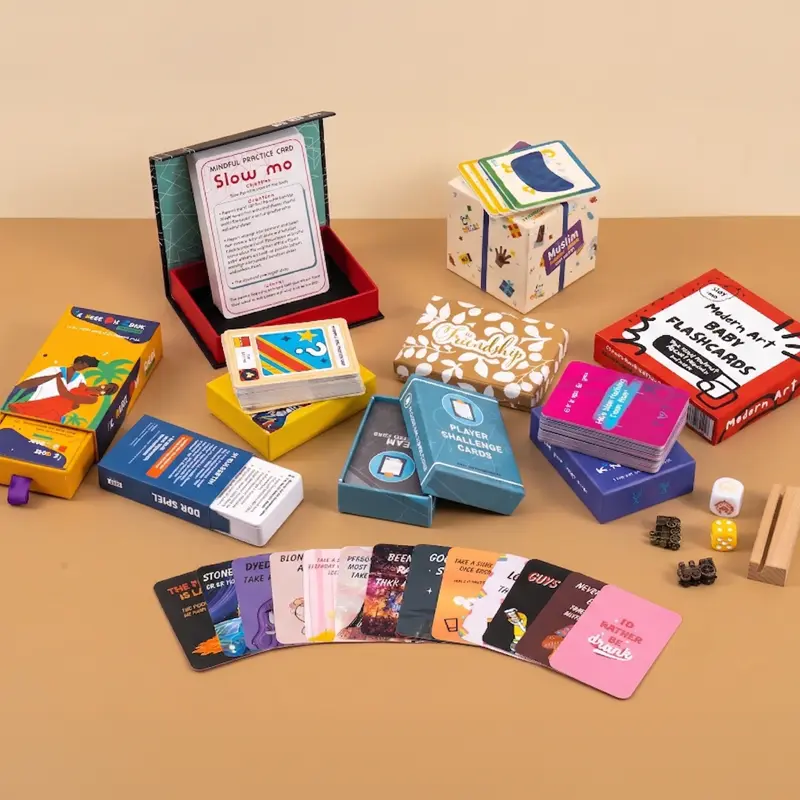
A card deck box is sized from the inside out. The finished deck sets the internal space, and the box is drawn around it. Our packaging page states that rule: papier cartonné, état de surface, deck count, and accessories change the finished stack height and internal clearance.
This guide works through that order using our own reference pages, including the card size reference et le materials table. It covers the arithmetic, the structures, the clearance for inserts, and the pack-out check before card deck packaging goes to production.
Start With the Finished Deck, Not the Box
The inputs come first. Le packaging page lists six details to send with an inquiry:
- Finished card size.
- Cards per deck.
- Number of decks.
- All extra components.
- Preferred opening style.
- Target retail and freight pack-out.
A dieline drawn before those six are fixed gets redrawn. Each one moves a box dimension: the card size sets the footprint, the deck count sets the depth, and the component list decides whether the pack needs compartments. The same page states the rule directly: lock the product before the box.
Card size is a finished measurement in millimeters plus a corner radius. The size reference lists mini at 44 × 64 mm in R3 and poker at 63 × 88 mm in R3 or R5. Tarot measures 70 × 120 mm in R6, flash 77 × 127 mm in R5, and square 100 × 100 mm in R5. R is the corner radius in millimeters, so R6 rounds a corner more than R3.
The same page sets the artwork rule: finalize the finished size and corner radius before applying bleed, trim, and safe-area guides. Box work starts at the same point. It also notes that common formats simplify sleeves and packaging, and asks for any sleeve constraints together with the deck count.
Turn Card Count Into Stack Height
Stack height is card count multiplied by finished card thickness. The materials page publishes a per-card reference for coated boards, shown below with the 55-card column calculated from it.
| Stock | Varnished | Feuilleté | 55 cartes, varnished | 55 cartes, laminated |
|---|---|---|---|---|
| 300 GSM C2S | 0.325 mm | 0.357 mm | 17.9 mm | 19.6 mm |
| 350 GSM C2S | 0.382 mm | 0.4125 mm | 21.0 mm | 22.7 mm |
| 400 GSM C2S | 0.416 mm | 0.458 mm | 22.9 mm | 25.2 mm |
The materials page marks that table as reference only, because actual thickness varies by mill and paper construction. The paperboard reference explains why: paperboard is a multi-ply material rather than a single sheet, so ply build shapes the height as much as the grammage does. Two decks at the same GSM can still sit at different heights.
Sleeved decks need the same treatment. A sleeve adds to each card, so a loose stack is not the stack the box must hold. Fix the card count and the sleeve decision before the dieline, then re-measure the sleeved stack on the sample. Our paper weight guide covers the units if your spec sheet uses a different one.

Size a Tuck Box for Retail Decks
Le customization page describes the tuck-end box as the most common packaging for custom playing card decks and trading cards. It is described as lightweight, rentable, et facile à assembler, which suits retail card games, jeux de poker, and starter decks. The page adds that the structure allows high-quality offset printing and branding customization.

For that structure the packaging page asks you to define the finished card size, action, finition, card count, and opening direction before the dieline. Those five inputs also set the flap positions, so a change to card count or finish moves the dieline again.
Shrink wrap is listed on the same pages as a separate option rather than a box. The customization page describes it as a tamper-evident seal that protects cards from dust, humidité, et dommages pendant l'expédition et l'affichage au détail. The packaging page then asks for film type and thickness, bundle count, seal position, and retail pack dimensions. See the playing card decks et le cardstock guide for the stock behind that decision.
Choose Rigid Boxes for Heavier Sets
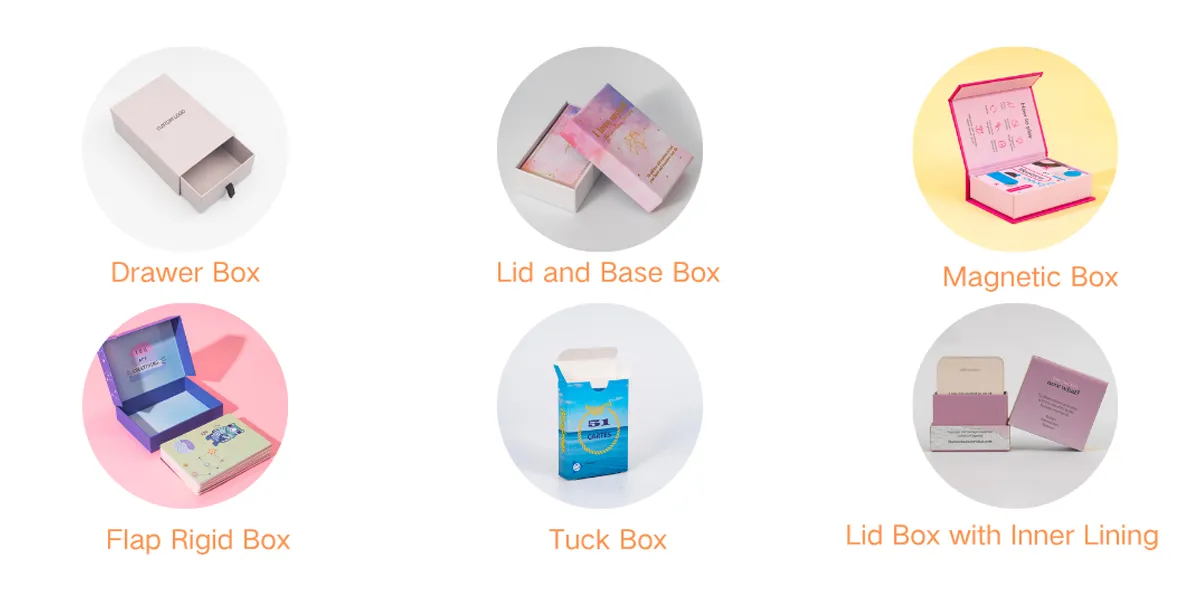
Rigid formats keep their shape and suit component-heavy sets. The customization page describes magnetic rigid boxes as built from rigid board with a magnetic closure lid, used for limited-edition sets, crowdfunding card games, and high-value collectibles. Lid and base boxes are listed as two-piece formats with stacking strength for board game storage and deluxe sets. Drawer boxes pair an outer sleeve with a sliding inner tray.

What you define before the dieline changes with the structure. For a drawer box the packaging page asks for a complete component list, a pull style, internal clearance, and the insert. For book-style or lid and base boxes it asks for deck arrangement, rulebook, accessories, compartments, and opening sequence. Ring binding has its own list of ring material, card quantity, hole position, and card size.
These formats are machine-built. Le manufacturing page lists a corner pasting machine rated at up to 35 à 40 rigid boxes per minute and a rigid box forming line. It also lists a lid and base line supporting a wide range of box sizes and materials. Ask which line runs your size, and ask what happens to a box outside that range. The same page names magnetic lids among the packaging structures made in-house.
Leave Clearance for Inserts and Rulebooks
Card dimensions are only the start. The packaging page states that the structure must also allow for finished deck thickness, livres de règles, faire des dés, jetons, pochettes, diviseurs, inserts, and international transit. Each of those competes for the same internal space.

The customization page lists the usual accessories: game tokens, faire des dés, play money, sand timers, drawstring bags, and metal pieces. The manufacturing page then verifies them during final assembly. Functional fit testing covers boxed sets and trays, and component checklists confirm card count and accessory inclusion.
A folded board is the usual surprise. The customization page offers no-fold, bi-fold, tri-fold, and quad-fold game board layouts, chosen so a board fits neatly inside the packaging box. The fold decision changes the box footprint, not only the board. Index-divider boxes, tin boxes, metal and plastic rings, and custom inserts are listed as additional structures on the packaging page.
Le buyer FAQ confirms that one project can hold decks, rigid or folding boxes, guides, pochettes, inserts, and shrink wrap. Selected game accessories join the same pack, with compatibility settled during quoting and sampling. That matters because every component added after the dieline is approved changes the internal space the box must hold. Our card game decks et tarot size guide show how the same inputs play out across formats.
Prove the Pack Before Mass Production
The pre-production sample is where a box is checked rather than assumed. Le sampling page says that route verifies the selected size, matériel, imprimer, finition, conditionnement, and component fit, and its confirmation list names box fit, component count, opening experience, and pack-out. A card deck with its box starts at 200 ensembles, and a custom sample runs 5 à 7 working days as a reference.

Export packing is the last measurement to get wrong. Le shipping page specifies BC double-wall corrugated cartons at around 6.5 à 7.5 mm with gross weight kept within 15 kg per carton, and palletized shipments on ISPM 15-compliant pallets. The corrugated fiberboard reference covers how that board is specified by construction and flute. The FAQ adds rigid-box freight detail: individual wrapping, reinforced cartons, internal corner and void protection, moisture barriers, and palletization.
Lead times follow the box, not only the cards. The same page publishes a production reference by structure and quantity band, measured in working days.
| Produit | Under 5K | Under 10K | Higher quantity |
|---|---|---|---|
| Cartes | 10 jours | 10 jours | +1 day / 10K |
| Cartes + folding box | 10 jours | 12 jours | +1 day / 3K |
| Cartes + boîte rigide | 12 jours | 15 jours | +1 day / 3K |
| Couvercle et boîte de base | 12 jours | 14 jours | +1 day / 3K |
| Book-style box | 12 jours | 17 jours | +1 day / 3K |
| Drawer / cigarette box | 12 jours | 18 jours | +1 day / 3K |
The page adds approximately six days for order processing, dielines, préparation du dossier, proofing, and production scheduling after artwork confirmation. Add those days to whichever row applies before you commit to a launch date.
Foire aux questions
How do I size a box for a sleeved deck?
Measure the sleeved stack, not the loose one. The size reference asks for sleeve constraints together with the deck count, and the pre-production sample is where the sleeved fit is confirmed against the box.
Which box suits a first card deck?
The customization page describes the tuck-end box as lightweight and cost-effective for retail decks, while magnetic rigid, lid and base, and drawer formats are positioned for limited-edition and deluxe sets. Choose by what the product has to hold and how it opens.
What is the minimum order for a deck with a box?
The sampling page lists 200 sets as the starting quantity for a card deck supplied with its box. A project printing one card design only starts at 1,000 pieces.
Can the box and the cards be designed together?
Oui. The customization page lists set and packaging design, covering tuck boxes, boîtes rigides, plateaux, livrets, and accessories. The buyer FAQ confirms that combined projects are quoted and sampled as one package.
Pensées finales
Good card deck packaging starts with a fixed deck. Lock the card size, radius, action, count, and accessories, convert the count into stack height, then choose the structure that holds that stack with room for sleeves and transit. Confirm the result on a pre-production sample before the full run.
Send the finished size, card count, composants, and preferred opening style through our contact page. We check them against the dieline and the packing line before a sample is made.
Check a Box Dieline