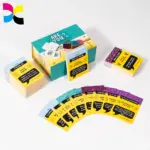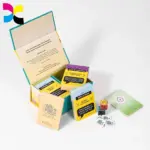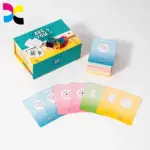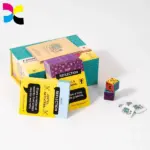
Ya sea que estés diseñando tu propia baraja de tarot única, lanzando una campaña de crowdfunding en Kickstarter, o buscando un fabricante profesional de cartas de tarot, comprensión tamaño de la carta del tarot es el primer paso hacia la creación de una plataforma de alta calidad.
En términos generales, Las cartas del tarot se originaron en Italia durante el siglo XIV como una baraja de 78 Cartas que se utilizaban originalmente para juegos de cartas como el Tarot francés.. Con el tiempo, Evolucionaron hasta convertirse en una de las herramientas más populares del mundo para la adivinación y la guía espiritual.. Hoy, Las lecturas de tarot se utilizan comúnmente para explorar preguntas relacionadas con amar, casamiento, familia, carrera, educación, y crecimiento personal. Cuando las personas se sienten inseguras acerca de su situación actual o buscan claridad., Las cartas del tarot a menudo se consultan para proporcionar información y ayudar a guiar decisiones futuras..
Una baraja de tarot tradicional consta de 78 tarjetas, dividido en dos grupos principales: el Arcanos mayores (22 tarjetas) y el Arcanos menores (56 tarjetas). Los Arcanos Mayores presentan cartas numeradas y con nombres individuales., a partir de El tonto (0) y terminando con El mundo (XXI). Juntos, estas tarjetas simbolizan diferentes etapas del crecimiento humano, experiencias de vida, y desarrollo espiritual, formando lo que comúnmente se conoce como “El viaje del tonto.” A través de imágenes simbólicas, incluidas personas, cuerpos celestes, y conceptos abstractos: los Arcanos Mayores cuentan una historia de transformación, sabiduría, y autodescubrimiento.
El Arcanos menores consiste en 56 tarjetas dividido en cuatro palos: varitas, tazas, espadas, y Oros. Cada traje representa un aspecto diferente de la vida y contiene diez cartas numeradas (Del as al diez) junto con cuatro cartas de la corte: Página, Caballero, Reina, y rey. Juntos, los Arcanos Menores reflejan experiencias cotidianas, emociones, relaciones, desafíos, y asuntos prácticos, complementando las lecciones de vida más amplias representadas por los Arcanos Mayores.
En esta guía, cubriremos los más comunes tamaños de cartas del tarot, comparar diferentes dimensiones, compartir recomendaciones prácticas de diseño, explicar cómo utilizar un plantilla de carta de tarot, y explora opciones personalizadas de impresión de cartas del tarot para ayudarte a darle vida a tu proyecto.
Tamaño de las cartas del Tarot:¿Cuál es el tamaño estándar de las cartas del Tarot??
Tamaño estándar de la carta del Tarot
Cuando la gente busca “tamaño de la carta del tarot,” Por lo general, se refieren a las dimensiones tradicionales utilizadas por la mayoría de las barajas de tarot impresas comercialmente..
El tamaño de carta de tarot estándar es:
- Ancho: 2.75 pulgadas (70 mm)
- Altura: 4.75 pulgadas (120 mm)
- Relación de aspecto: Aproximadamente 1:1.7
Este tamaño se ha convertido en el estándar de la industria porque proporciona el equilibrio ideal entre visibilidad de las obras de arte, facilidad de manejo, y barajar comodidad. Su formato más grande ofrece un amplio espacio para ilustraciones complejas., simbolismo, y descripciones de tarjetas sin dejar de ser cómodo de sostener durante las lecturas.
Otros tamaños comunes de cartas del Tarot
Otros tamaños comunes de cartas del Tarot
A pesar de 70 × 120 mm es el más utilizado, Las barajas de tarot personalizadas están disponibles en muchos tamaños..
| Tipo de tamaño | Pulgadas | milímetros | Mejor para |
| Mini tarot | 1.75″ × 3″ | 44 × 76 mm | Cubiertas de viaje |
| Tarot de bolsillo | 2.25″ × 3,5″ | 57 × 89 mm | llevar todos los días |
| Tarot estándar | 2.75″ × 4,75″ | 70 × 120 mm | La mayoría de las barajas de tarot |
| Tarot Grande | 3.5″ × 5,5″ | 89 × 140 mm | Ediciones de coleccionista |
| Tarot de gran tamaño | 4″ × 6″ | 102 × 152 mm | Mostrar o enseñar |
Elegir lo correcto tamaño de la carta del tarot depende de varios factores, incluyendo tu público objetivo, estilo artístico, y uso previsto. Por ejemplo, Las tarjetas de tamaño estándar son ideales para las lecturas diarias., mientras que las plataformas mini o de bolsillo son perfectas para la portabilidad. Los formatos más grandes ofrecen más espacio para obras de arte detalladas., convirtiéndolos en una opción popular para las ediciones de coleccionista, juegos de regalo premium, y fines de exhibición o enseñanza.. Seleccionar el tamaño adecuado no sólo mejorará la experiencia del usuario sino que también ayudará a que su baraja de tarot se destaque en el mercado..
¿Qué tamaño tienen las cartas del tarot en comparación con los naipes??
Muchos creadores que son nuevos en el tarot sienten curiosidad por saber en qué se diferencia de los naipes estándar..
El siguiente es un breve cuadro comparativo.:
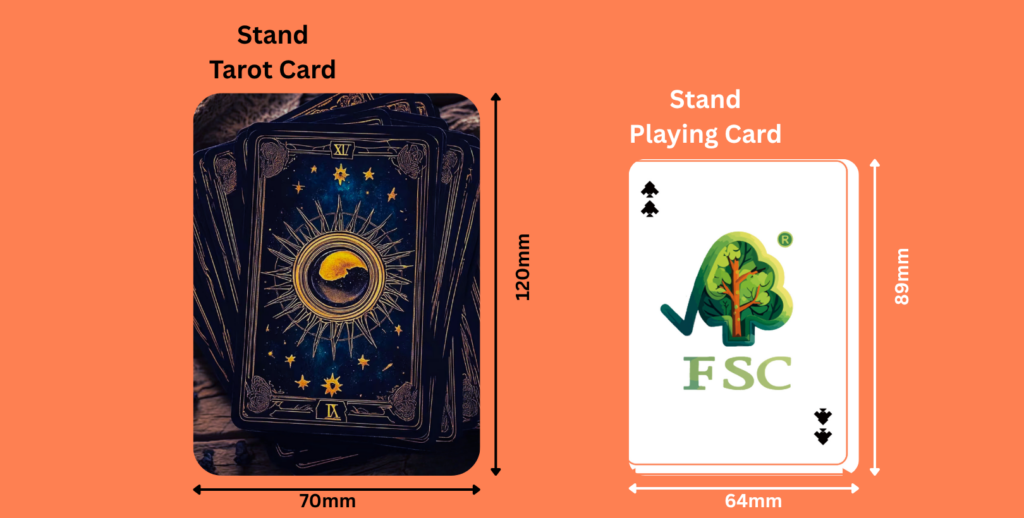
Cartas de Póquer 2.5″ × 3,5″ (64 × 89 mm)
Cartas del Tarot 2.75″ × 4,75″ (70 × 120 mm)
Como se muestra en la comparación anterior, Las cartas del tarot son notablemente más altas y ligeramente más anchas que las cartas estándar..
Este formato más grande proporciona varias ventajas.. Ofrece más espacio para ilustraciones detalladas., simbolismo intrincado, y obras de arte decorativas: elementos esenciales en la lectura del tarot, donde la claridad visual y las imágenes simbólicas juegan un papel importante. El mayor tamaño de la tarjeta también permite texto, iconos, y finos detalles de diseño para ser más legibles, mientras que la cartulina premium mejora la experiencia táctil general.. Como resultado, Las barajas de tarot suelen ofrecer un impacto visual más fuerte y una experiencia de lectura más inmersiva..
Sin embargo, las dimensiones más grandes también requieren un embalaje de tamaño adecuado, cajas de almacenamiento, y accesorios para proteger las tarjetas y mantener su calidad en el tiempo.
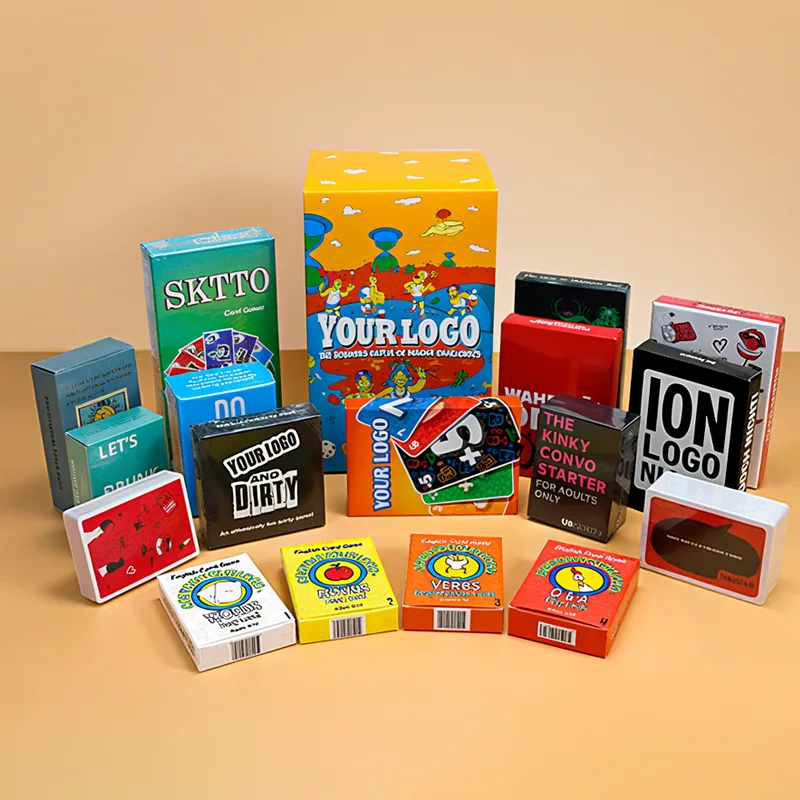
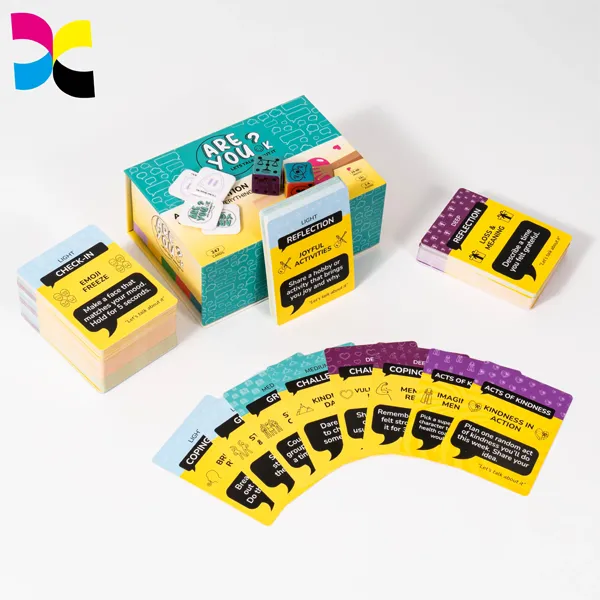
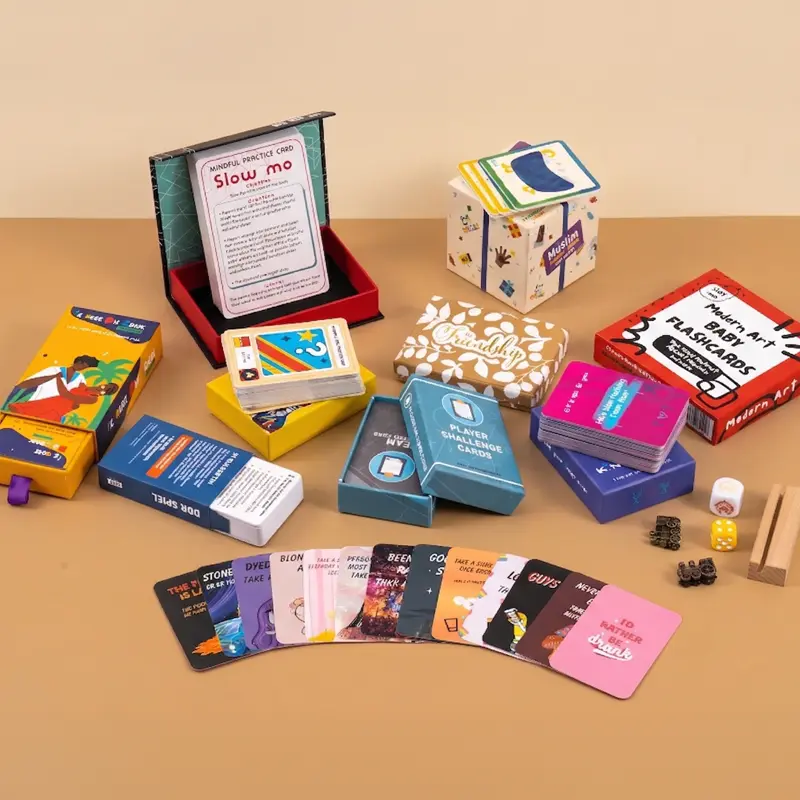
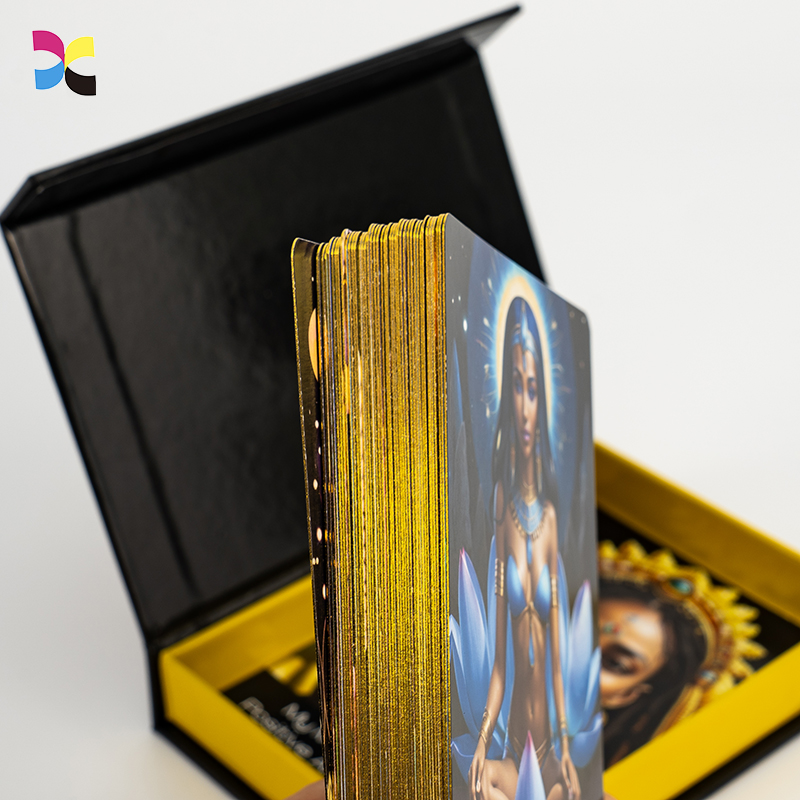
En general, cartas se envasan más comúnmente en cajas estándar, que son livianos, compacto, y rentable. barajas de tarot, por otro lado, tienden a estar empaquetados en cajas rígidas con cierre magnético premium. Porque las cartas del tarot son más grandes, contener más tarjetas (típicamente 78), y a menudo se consideran productos coleccionables o artísticos en lugar de naipes casuales., Los envases de alta gama reflejan mejor su valor.. Muchas barajas de tarot personalizadas también cuentan con opciones de acabado de lujo, como estampado de lámina de oro, papel de plata, Spot UV, o realce, creando una experiencia de unboxing más elegante.
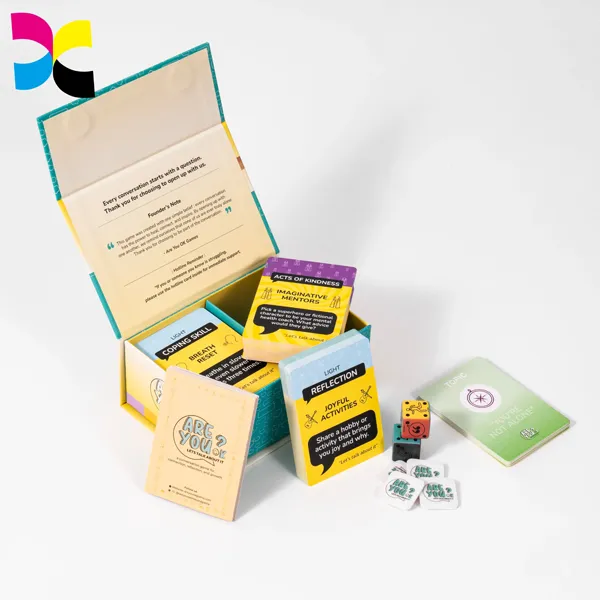
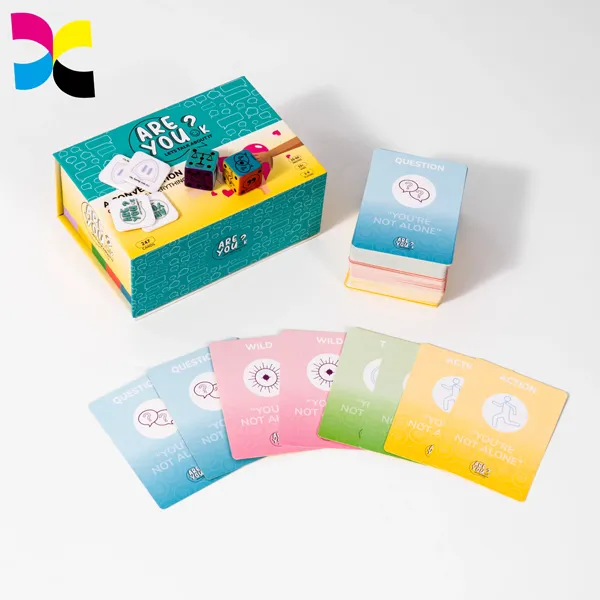
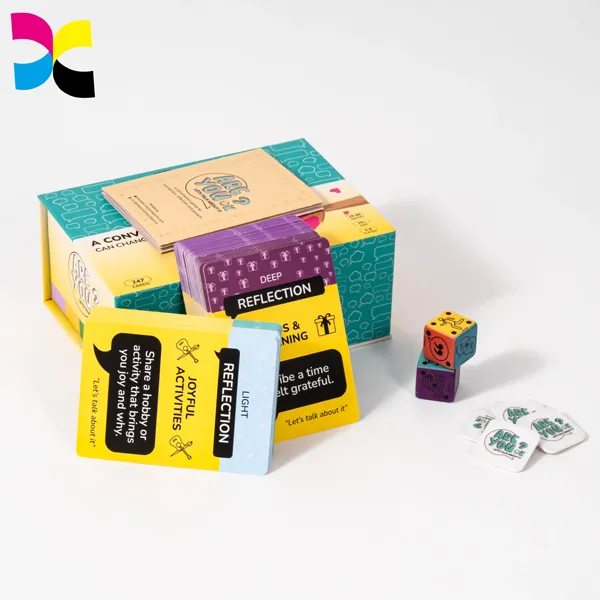
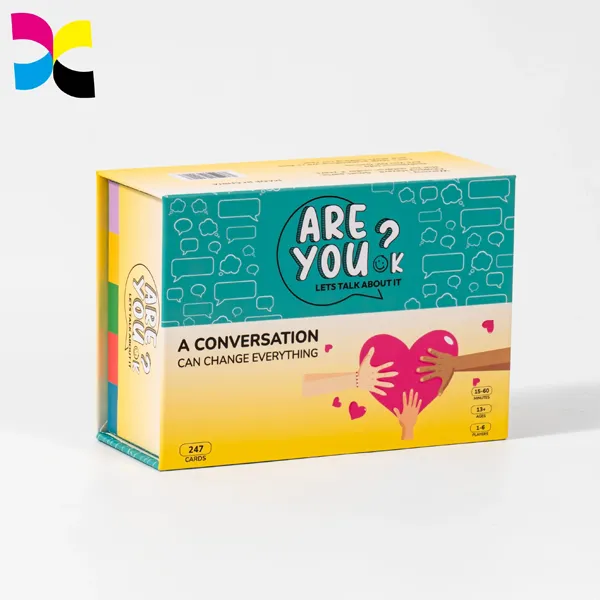
La siguiente imagen muestra un típico Baraja de tarot empaquetada en una caja rígida magnética de primera calidad., Con una construcción de alta calidad y un lujoso acabado estampado.:
Plantilla de carta de tarot & Guía de diseño
Antes de imprimir tus cartas del tarot, preparar un archivo de diseño profesional es esencial. Aquí, proporcionamos un plantilla de carta de tarot disponible para descargar. Probar!
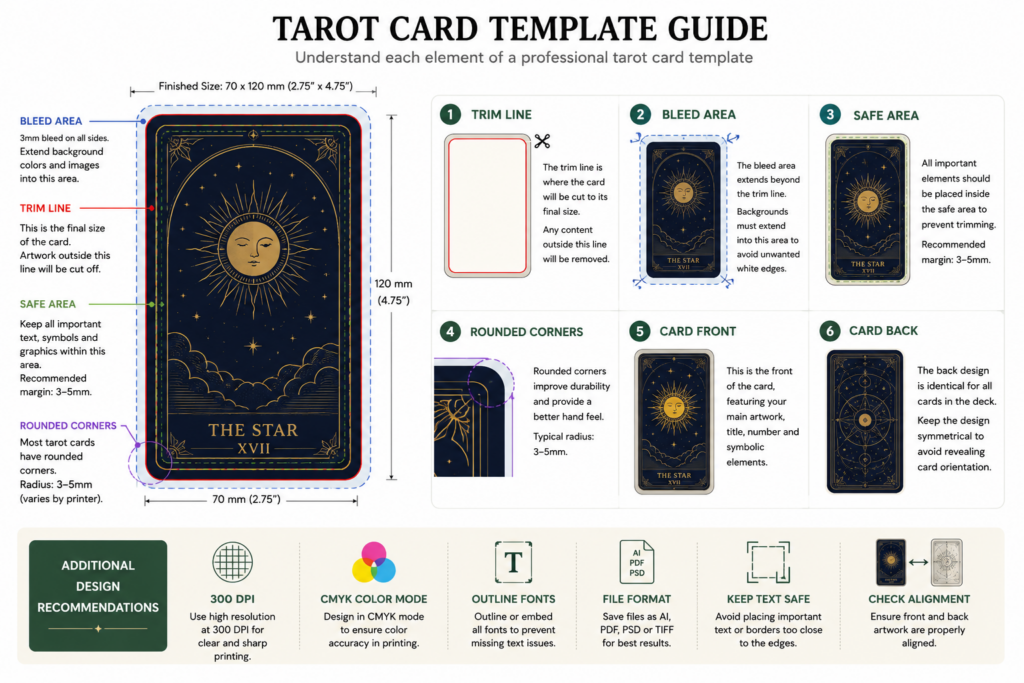
Primero, Presentemos los elementos incluidos en una plantilla típica de carta de tarot..
1. Línea de recorte
La línea de corte indica el borde de corte final de la tarjeta.. Después de imprimir, Las tarjetas se cortarán con precisión a lo largo de esta línea para alcanzar el tamaño final.. Cualquier contenido fuera de la línea de corte se eliminará durante el proceso de corte..
2. Área de sangrado
El área de sangrado está ubicada fuera de la línea de corte y generalmente se extiende 3 mm más allá de cada borde de la tarjeta. El color de fondo o el diseño en esta área deben coincidir con la propia tarjeta para evitar bordes blancos causados por ligeras imprecisiones en el corte..
3. Área Segura
El área segura es la región dentro de la línea de corte.. Todos los elementos de diseño de la tarjeta, como los símbolos., texto, e ilustraciones—deben permanecer dentro de esta área. Mantenga todo el contenido de diseño importante dentro del área segura, y generalmente se recomienda dejar un margen de 3–5mm desde el borde.
4. Esquinas redondeadas
La mayoría de las cartas del tarot utilizan esquinas redondeadas en lugar de esquinas cuadradas y afiladas.. Hay muchos tipos de esquinas redondeadas., y las cartas del tarot suelen utilizar un radio de esquina de 3–5mm.
5. Frente de la tarjeta
El anverso de la carta es el anverso de tu carta del tarot.. Todas tus obras de arte, ilustraciones, simbolos, numeración, y otros elementos de diseño se colocan en este lado. Dado que la naturaleza mística de las cartas del tarot depende en gran medida de la narración de la obra de arte de las cartas y de la experiencia visual transmitida por sus símbolos., los diseñadores deberían usar imágenes de alta resolución (300 PPP) y Modo de color CMYK.
6. Dorso de tarjeta
Como sugiere el nombre, este es el reverso de la carta del tarot. Generalmente, Todas las cartas de una baraja de tarot comparten el mismo diseño del reverso.. Por supuesto, dependiendo de tu diseño, También puedes crear múltiples diseños de reverso de tarjeta diferentes.. como el frente, Los elementos de diseño importantes deben permanecer dentro del área segura..
Entonces, ¿Cómo diseñas tus cartas del tarot??
En general, el proceso consta de cuatro partes: tema de la historia, estilo visual, estilo de borde, y método de creación.
1. Tema de la historia
Determine el tema de su historia: ¿qué mensaje quiere expresar su historia?, y ¿qué valores generales transmite?? Se recomienda escribir un esquema de la historia usted mismo para conectar todas las historias de los personajes..
Define el trasfondo de tu historia, incluyendo el periodo de tiempo, ambiente, perspectiva, y personajes involucrados. Construye el conflicto principal de la historia.. ¿Por qué el protagonista no puede cooperar con los otros personajes o fuerzas?? El conflicto debe corresponderse estrechamente con el trasfondo para que el protagonista se sienta creíble.. Por ejemplo, si no hay un problema obvio pero el protagonista aún quiere derrocar al poder gobernante, Los lectores pueden encontrar la historia confusa..
Una vez establecido el marco de la historia, exprésalo a través de tus ilustraciones de cartas del tarot, simbolos, y elementos visuales.
2. Estilo visual
El estilo visual determina el tono general de toda la plataforma.. Puedes elegir estilos como fantasía., fantasía oscura, dios del sol o mitología oriental, astrología mística, y más. Diferentes estilos atraen a diferentes públicos y propósitos de lectura.. Las personas que disfrutan de la aventura o el cosplay pueden preferir estilos astrológicos o de fantasía oscura., mientras que las lecturas con temas amorosos pueden adaptarse a una estética de ensueño. Por supuesto, Los diseñadores también son libres de crear según su estilo artístico preferido..
3. Estilo de borde
La cenefa ayuda a unificar toda la baraja.. Hay dos enfoques de diseño principales.:
Diseño centrado en los personajes
Cada carta resalta un solo personaje., con diferentes diseños de bordes utilizados para diferentes personajes.
Diseño centrado en la historia
Cada tarjeta representa una escena o un segmento de la historia.. Una sola historia puede abarcar varias cartas., con el mismo estilo de borde usado a lo largo de esa historia.
4. Método de creación
Método 1: Creación asistida por IA
Este es actualmente el método que requiere menos experiencia en dibujo y diseño.. La idea central es utilizar IA para generar obras de arte en el estilo deseado y luego refinar y ajustar manualmente los resultados..
Método 2: Dibujo a mano o ilustración de tableta digital
Paso 1: Crear bocetos
Utilice un lápiz o una tableta de dibujo para dibujar poses de personajes y decoraciones de tarjetas.. Durante esta etapa también se pueden utilizar herramientas de diseño como Canva..
Paso 2: Refinar y colorear
Colorea la obra de arte en Canva, o importar los bocetos a software como Photoshop, usando herramientas como la herramienta Pluma para rastrear, refinar, y finalizar la obra de arte. Al colorear, puedes intentar usar funciones como Mapa de degradado para crear variaciones de color más ricas.
Paso 3: Combinar recursos de diseño
Durante el proceso de diseño, Puede incorporar con confianza recursos adicionales para ayudar a su obra de arte.. Por ejemplo, aplique pinceles de textura como fondos o agregue elementos decorativos como cuentas. La clave es combinar estos recursos de forma natural con su obra de arte dibujada a mano para que el diseño final parezca completo y cohesivo..
Una vez todo 78 tarjetas han sido diseñados, puedes preparar tus archivos para imprimir.
Impresión personalizada de barajas de cartas del Tarot
Después de completar los diseños de sus tarjetas y preparar los archivos listos para imprimir, Puedes enviarlos a un fabricante de impresión profesional para producir tu baraja de tarot personalizada.. Impresión Xinyi ofrece servicios premium de impresión al por mayor con mano de obra de alta calidad., producción directa de fábrica, y precios directos del fabricante para ayudarle a llevar sus cartas del tarot al mercado. Contáctenos hoy para comenzar su proyecto de impresión de cartas del tarot personalizado!
Los elementos claves de impresion de cartas del tarot incluir papel, acabado superficial, técnicas de impresión, y opciones de embalaje.
Primero, al seleccionar el tipo de papel, Las cartas del tarot generalmente ponen mayor énfasis en una apariencia y sensación premium.. Las opciones de cartulina comunes incluyen:
- 300papel de arte del G/M C2S
- 310Papel de base negra gsm
- 330Papel central negro alemán gsm
- Cartulina de juego premium de calidad de casino
Las opciones comunes de acabado de superficies incluyen:
- Laminación mate
- Laminación brillante
- Acabado de lino.
- Laminación suave al tacto
- Recubrimiento UV spot
Estas técnicas de acabado no solo protegen la obra de arte impresa sino que también crean experiencias táctiles distintivas..
Para enfatizar la atmósfera mística y el simbolismo radiante que a menudo se encuentran en las ilustraciones de las cartas del tarot., estampado Es una de las técnicas de impresión más utilizadas para las barajas de tarot..
Las opciones de empaque profesionales para cartas del tarot incluyen:
- Cajas de papel plegables
- Cajas Rígidas de Dos Piezas
- Cajas Rígidas con Cierre Magnético
- Cajas de regalo estilo cajón
- Cajas de regalo de edición de coleccionista
Muchas editoriales también incluyen guías, insertar tarjetas, y accesorios personalizados dentro del embalaje para crear una experiencia de unboxing más completa y premium.
Conclusión
Elegir lo correcto tamaño de la carta del tarot es un paso importante en el diseño de una baraja de tarot exitosa. Aunque el tamaño estándar de 70 × 120 mm (2.75 × 4.75 pulgadas) sigue siendo la opción más popular, Las dimensiones personalizadas a menudo pueden adaptarse mejor a estilos artísticos específicos o demandas del mercado..
Además del tamaño de la tarjeta., seleccionando el apropiado papel, acabado superficial, método de impresión, y solución de embalaje puede mejorar significativamente tanto el atractivo visual como la durabilidad de su baraja de tarot. Trabajar con un fabricante experimentado en impresión de cartas de tarot personalizadas garantiza que su obra de arte se reproduzca con precisión y que el producto terminado cumpla con los estándares de calidad profesionales..
Ya sea que esté planeando lanzar su primera baraja de tarot independiente o ampliar una línea de productos existente, comprensión tamaños de cartas del tarot y el proceso de impresión le ayudará a crear una plataforma visualmente impresionante y altamente funcional..
Elegir Impresión Xinyi para darle vida a tus cartas del tarot artístico premium!
Preguntas frecuentes sobre el tamaño de las cartas del Tarot
¿Cuál es el tamaño estándar de la carta del tarot??
El tamaño estándar de la carta del tarot es 2.75 × 4.75 pulgadas (70 × 120 mm), que es utilizado por la mayoría de las barajas de tarot comerciales..
¿Las cartas del tarot son más grandes que las del póquer??
Sí. Las cartas del tarot son más altas y ligeramente más anchas que las cartas de póquer estándar., proporcionando más espacio para obras de arte y simbolismo.
¿Puedo personalizar el tamaño de mis cartas de tarot??
Absolutamente. Los fabricantes profesionales pueden producir cartas del tarot en dimensiones personalizadas para satisfacer sus requisitos de diseño y marca..
¿Cuál es la mejor cartulina para las cartas del tarot??
Las opciones populares incluyen 300papel artístico gsm, 310papel de base negra gsm, y 330Papel de núcleo negro alemán gsm, dependiendo de la durabilidad y manejo deseados.
¿Qué resolución debe tener la obra de arte de las cartas del tarot??
Para impresión profesional, Las obras de arte deben prepararse en 300 PPP en CMYK modo de color.
¿Qué embalaje es mejor para las barajas de tarot??
Las opciones de embalaje más comunes incluyen cajas plegables., cajas rígidas, cajas de regalo magnéticas, y cajones. Las ediciones premium suelen incluir guías y encartes personalizados..
¿Puedo imprimir una pequeña cantidad de cartas de tarot personalizadas??
Sí. Muchas imprentas profesionales ofrecen cantidades mínimas de pedido bajas. (MOQ) para artistas independientes, creadores, y campañas de crowdfunding, mientras que las tiradas de producción más grandes generalmente proporcionan costos unitarios más bajos.
¿Qué sangrado debo utilizar al diseñar cartas del tarot??
A 3 mm de sangrado Se recomienda garantizar que el diseño del fondo se extienda más allá de la línea de recorte., evitando bordes blancos después del corte.